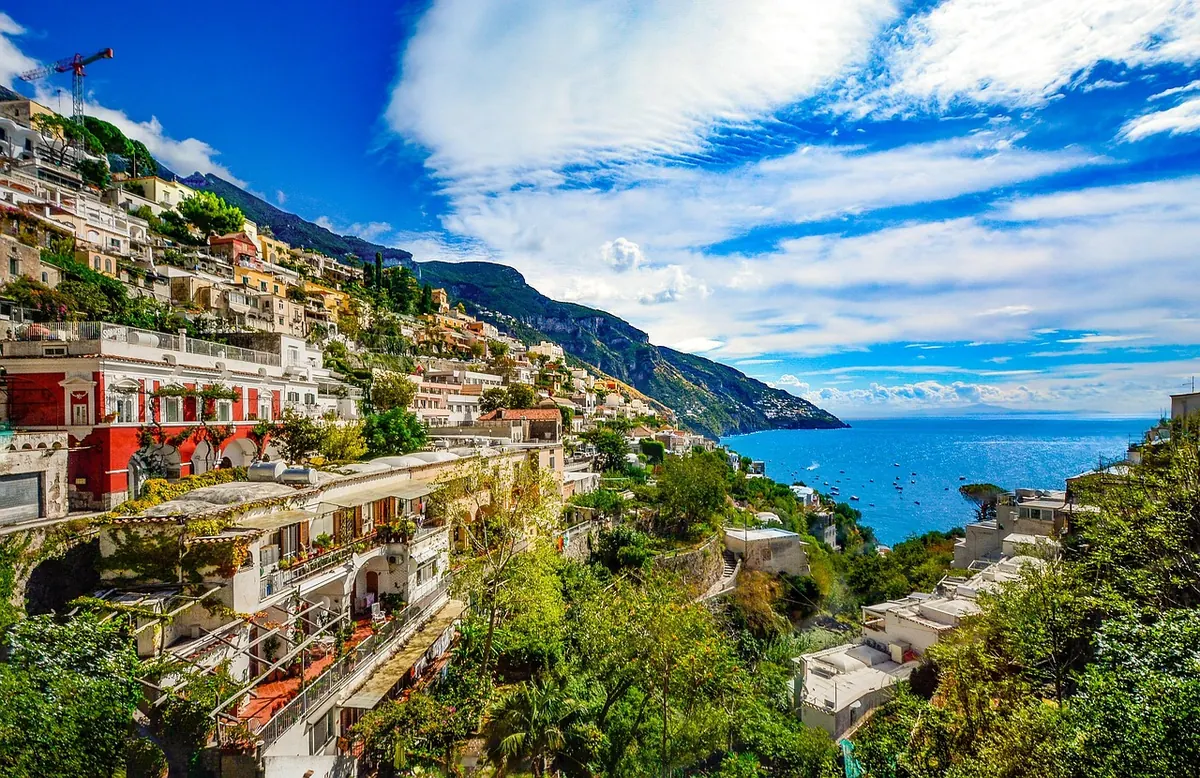
The Amalfi Coast road looks wonderful in photographs and feels like a mistake behind the wheel. The SS163 is the only real road hugging this stretch of coastline, and in places it narrows to a single lane bending around a blind corner high above the sea. Add coaches, scooters, delivery vans and a summer's worth of traffic, and a twenty-minute hop between towns can take an hour. Finding parking in Positano or Amalfi can swallow an afternoon — and what you pay for the space may cost more than a week of ferry tickets.
There is also the small matter of the law. From April to October, a rotating number-plate scheme restricts cars on stretches of the SS163, so even a rental car is not the freedom it first appears to be.
Ferries, buses and old stone staircases do the job better. Here is how to link the coast's towns without touching a car key.
Getting There Without a Car
Naples is the usual gateway, and two rail lines do most of the work. Trenitalia's fast trains run from Napoli Centrale to Salerno in around forty minutes; from Salerno station it is a short bus ride or a twenty-minute walk to the ferry dock. The Circumvesuviana commuter train runs from Napoli Garibaldi, on the lower level of the main station, to Sorrento in about an hour — cheap and straightforward, though often standing room only with luggage squeezed into the aisle.
From Naples Capodichino airport, the Alibus shuttle runs to Napoli Centrale and to Molo Beverello, the ferry port, in about half an hour. That single connection is worth knowing: you can land, ride a bus, and be on a boat to Positano the same afternoon.
Both Salerno and Sorrento are ferry terminals, so you can step off a train and onto a boat the same day. From Rome, take a high-speed train to Salerno and continue by sea. In summer, seasonal ferries also link Naples' Molo Beverello directly with Sorrento, Positano and Amalfi, which is the most pleasant arrival of the lot.
Ferries: The Coast's Real Highway
Ferries are faster, cooler and far more scenic than the road, and the network is simple once you see it as a spine running Sorrento–Positano–Amalfi–Salerno. Travelmar, NLG and Alilauro are the names you will see on timetables; buy tickets at the kiosks on the dock rather than online if your plans are fluid.
Rough crossing times:
- Sorrento to Positano: around 40 minutes
- Positano to Amalfi: around 25 minutes
- Amalfi to Salerno: around 35 minutes, often with stops at Minori, Maiori and Cetara
- Amalfi to Capri: seasonal, and a fine day out when the sea is calm
Two things to know. Most services run from roughly Easter to late October, thinning in the shoulder months, so check before you build a plan around a boat. And when the swell picks up, ferries are cancelled, sometimes with little warning. Sit towards the back if you are prone to seasickness, and keep a bus as your plan B.
Ravello has no ferry: the town sits more than 300 metres above the water and is reached by bus or on foot from Amalfi. Praiano's landing at Marina di Praia sees very limited service, so most people arrive there by bus.
Buses: Where SITA Sud Does the Heavy Lifting
The blue-and-white SITA Sud buses cover the coast road and the hills behind it. The main routes are Sorrento–Positano–Amalfi, Amalfi–Salerno, and the short but steep Amalfi–Ravello climb. A separate local service connects Amalfi with Agerola and Bomerano, which matters if you want to walk the Path of the Gods.
- Buy tickets at a tabacchi or a bar before boarding; drivers do not always sell them.
- Validate your ticket in the machine on board, or you risk a fine.
- In July and August, board at a terminus — Sorrento or Amalfi — if you want a seat. Mid-route stops in Praiano often watch full buses sail past.
- Timings are optimistic in high season. Treat the schedule as a suggestion and allow buffer time.
Walking: Staircases, Mule Tracks and One Famous Ridge
The coast is threaded with old mule tracks and flights of steps that connected villages long before the road existed, and they remain the fastest way between some pairs of towns. Ravello to Amalfi is the classic short descent: start near the Duomo, drop through Pontone and the terraces below, and reach Amalfi in roughly an hour and a half of knee-testing stairs. Going the other way is a hot, honest climb best attempted before ten in the morning.
Other routes worth building a day around:
- Path of the Gods (Sentiero degli Dei) — Bomerano to Nocelle, roughly three hours of ridge walking with the whole coast spread out below. Reach Bomerano by bus from Amalfi, then descend the 1,700 steps from Nocelle to Positano, or take the local bus down.
- Valle delle Ferriere — a shaded reserve above Amalfi with waterfalls, ferns and the ruins of old iron works. Entry is limited in high season, so check locally.
- Maiori to Minori — the short "Lemon Path" through terraced groves, easy enough for a slow afternoon.
- Praiano to Positano — the Via Positanesi d'America, a near-level coastal path cut into the cliff, with a swim stop at Arienzo if you are brave.
Carry water, wear shoes with actual tread, and remember that stairs on the Amalfi Coast are counted in hundreds, not dozens.
On this coast the timetable is a wish and the ferry is a rumour. Build your day around one fixed point and let everything else bend.
Choosing a Base With No Car
Where you sleep determines how much of the network you actually use.
- Sorrento — the best-connected hub: Circumvesuviana trains, SITA buses and fast ferries to Capri, Positano, Amalfi and Salerno. Ideal for a first visit and for day trips to Pompeii.
- Amalfi — the centre of the ferry spine and the bus interchange for Ravello, Agerola and Salerno. Everything in town is walkable.
- Positano — beautiful and vertical. Ferries stop here, but buses are often full by the time they arrive.
- Ravello — no ferry, one steep bus, and complete quiet once the day-trippers leave. Perfect if you are happy to plan around a handful of departures.
- Praiano and the smaller villages — cheaper and quieter, but reliant on buses; expect to walk.
- Salerno — a real city with a train station, a ferry terminal and affordable hotels. Underrated as a base.
A Three-Day Route That Actually Works
Here is a shape that uses boats as the backbone and buses only for the hills:
- Day one. Train to Sorrento, then the afternoon ferry to Positano. Wander the staggered lanes, swim at Fornillo, sleep in Positano.
- Day two. Morning ferry to Amalfi. Visit the Duomo and the paper museum, then take the bus up to Ravello for the Villa Cimbrone gardens and the Terrace of Infinity. Bus back down, sleep in Amalfi.
- Day three. Early bus to Bomerano and walk the Path of the Gods to Nocelle, descend to Positano, then take the ferry to Salerno — a long, satisfying line across the whole coast, ending at a train station.
Two practical rules make this work. Book accommodation near a ferry dock or a bus terminus, not halfway up a hill with 200 steps to the door. And travel with a soft bag: the aisles of the Circumvesuviana, the gangways of small ferries and the staircases of Positano were not designed for hard-shell suitcases with wheels.
Do it this way and the coast stops being a traffic problem. The sea covers the long distances, the bus takes the hills, and your legs handle the parts that were always meant to be walked.
Photo: user32212 / Pixabay