Japan is one of the easiest countries in the world to travel in, and one of the easiest to get subtly wrong. The trains run on time, the streets are safe, the food is superb, but the unwritten rules that keep everything humming rarely appear in a guidebook's first chapter.
None of the mistakes below will ruin a trip. They cost money, create small awkward moments, or waste time you would rather spend eating noodles. Here are nine that first-time visitors make most often, and how to avoid them.
1. Buying the Nationwide Rail Pass on Reflex
The Japan Rail Pass was once a near-automatic purchase. It isn't anymore. The nationwide pass costs considerably more than it used to, and a simple Tokyo–Kyoto–Osaka round trip may not earn back the price. Before you buy, sketch your long-distance legs, price them individually with a route planner, and compare honestly. If you are staying in one region, a regional pass from JR East, JR Kyushu, JR West or similar is often better value.
Two details catch people out. The pass covers JR trains only, so not the Tokyo Metro, not most private railways, and on many pass types the fastest Nozomi and Mizuho shinkansen services require an extra supplement. And activate it on the day you actually start travelling. A seven-day pass switched on at the airport can quietly expire while you are still settling into Kyoto.
2. Assuming Your Card Will Cover Everything
Japan is far more card-friendly than it was a decade ago, but cash still matters. Small ramen shops, temple stalls, rural buses, coin lockers, market vendors and some taxis expect yen. Carry a few thousand yen at all times and top up at a convenience store ATM or a Japan Post ATM, which generally accept foreign cards. Airport ATMs are reliable too; hotel front desks usually are not.
Keep small coins and ¥1,000 notes handy for shrine offerings, bus fares and vending machines. And do not leave a tip on the table. It is not expected, and staff will often chase you down the street to return it. A genuine "gochisousama deshita" as you leave means more.
3. Treating the Train Like Your Living Room
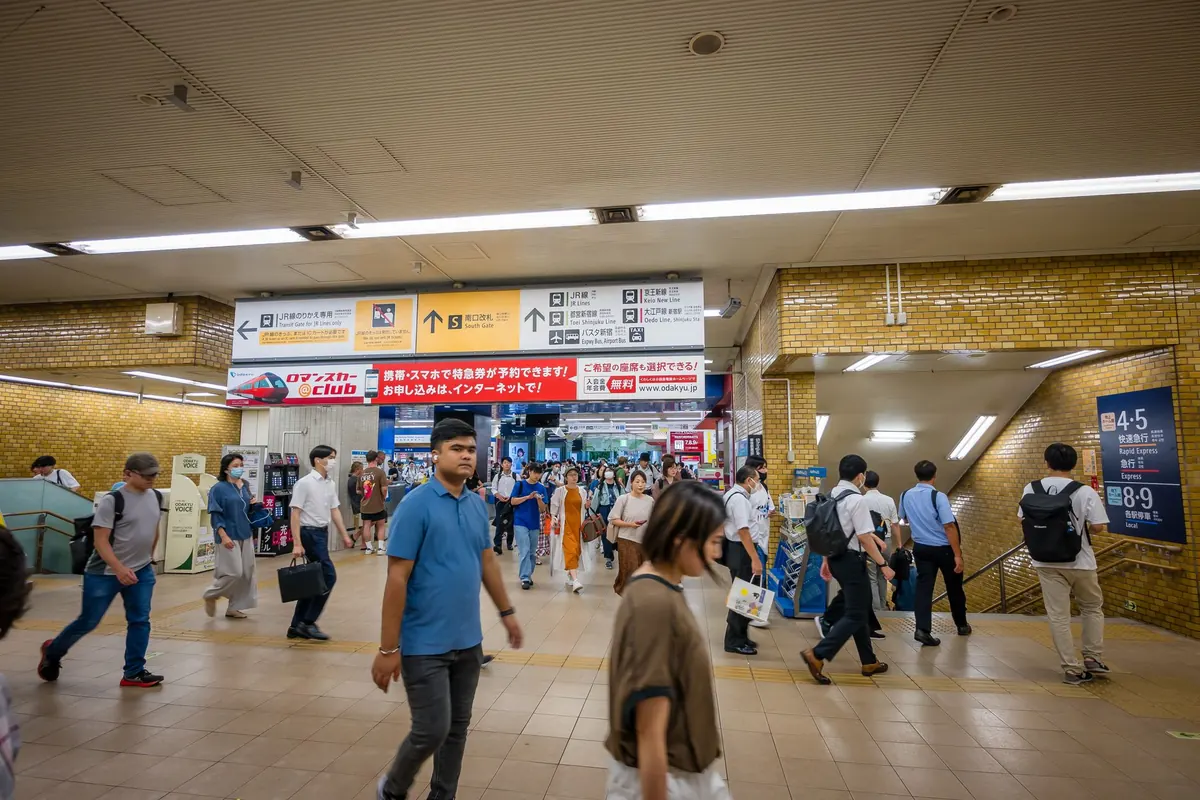
Japanese commuter trains are silent in a way that surprises visitors. A phone call is the classic mistake, partly because it draws every eye in the carriage. Set your phone to silent before you board and keep conversations to a low murmur.
Quiet-carriage basics
- No calls, ever. Take it to the platform or the next station if you must.
- Turn the screen brightness down and silence notification sounds.
- Skip eating on commuter trains. On a shinkansen or limited express, an ekiben is part of the pleasure, but avoid anything strongly scented.
- Keep headphones low enough that nobody else can hear them.
- Take your backpack off and put it in the overhead rack or on the floor between your feet.
- Stand to one side of the platform markings and let passengers off before you get on.
4. Skipping the Small Courtesies
Shoes. Watch for a step up at the entrance and a row of shoes. Ryokan, some restaurants, and temple or castle interiors all expect them off. Wear socks without holes.
Chopsticks. Never stand them upright in a bowl of rice, and never pass food from your chopsticks to someone else's. Both mirror funeral rituals. Rest them on the holder or across the bowl when you pause.
Shrines and temples. At a Shinto shrine, the usual pattern is two bows, two claps, one bow. At a Buddhist temple, bow quietly without clapping. Either way, keep your voice down and ask before photographing people or ceremonies.
Two more habits that smooth a day: don't eat while walking in busy market streets, and carry a small bag for your rubbish, because public bins are rare. Convenience store bins are meant for what you bought there.
5. Racing Through the Country
The classic first itinerary — Tokyo, Hakone, Kyoto, Osaka, Hiroshima, back to Tokyo in nine days — turns a holiday into a luggage-handling competition. Jet lag alone will cost you the first morning. Pick two bases, add day trips, and let one of them be slower than feels efficient.
Popular spots reward early starts. Fushimi Inari and Arashiyama's bamboo grove are far calmer before eight in the morning, and the same is true of most famous gardens. Move hotels less often than you think you need to; a single well-placed base often beats three rushed ones.
6. Leaving the Practical Bits to the Last Minute
Get a rechargeable IC card — Suica, Pasmo, ICOCA or a visitor version sold at airports — as soon as you land. It works on trains, buses, vending machines and in most convenience stores across the country, and it removes a hundred small decisions from your day.
Sort out connectivity before you fly: an eSIM or pocket wifi, plus offline maps in case you lose signal. Learn a handful of phrases — sumimasen, arigatō gozaimasu, kore wa ikura desu ka — and use them. Carry your passport, since foreign visitors are required to have it with them. If you are travelling with a large suitcase, ask your hotel about luggage forwarding; sending a bag ahead to your next city is common, affordable and removes the worst part of train travel.
Before You Fly: A Short Checklist
- Price your long-distance train legs before deciding on a rail pass, and note the activation date you actually want.
- Order an IC card or plan to buy one at the airport, and keep a few thousand yen in cash.
- Set your phone to silent before your first ride and rehearse your quiet-train habits.
- Book the two or three attractions that genuinely need reservations, and leave the rest loose.
- Install offline maps, save your hotel addresses in Japanese, and screenshot your bookings.
- Pack socks you would not be embarrassed to wear in a ryokan.
For anything involving visas, insurance or medication you take regularly, check the official rules for your nationality and speak to a qualified professional rather than relying on forum advice. Then relax: Japan is forgiving, and a well-mannered visitor with cash, an IC card and a quiet phone will have a very good trip.
Photo: Valent Lau / Pexels